AI · Mechanics · Multimaterial Manufacturing

Liuchao Jin

Researcher in Intelligent Matter & Advanced Manufacturing

From AI-driven intelligent matter to autonomous scientific discovery.

I combine machine learning, computational mechanics, and multimaterial 3D/4D printing to design adaptive structures and soft robots. My long-term goal is to connect reasoning, simulation, fabrication, and experiments in an evidence-grounded discovery loop.

Conceptual visualization linking AI-designed metamaterial lattices, intelligent multimaterial manufacturing, and a bio-inspired soft robotic gripper
AI-powered material discovery, intelligent multimaterial manufacturing, and bio-inspired soft robotics as one connected system.

Research profile highlights

  • Doctoral research CUHK · Hong Kong PhD Fellowship Scheme
  • Research experience CUHK · SUSTech · Westlake · McGill · SCU
  • Recent recognition 2026 Best Presentation & Best Poster Awards

Research arc

Design, manufacture, embody, and learn

One connected program links computational intent to verified physical behavior—and, in the long term, turns each result into knowledge for the next discovery cycle.

  1. 01

    Design

    Use learning, mechanics, and optimization to map a target response to a material architecture.

  2. 02

    Manufacture

    Translate digital architectures into multimaterial 3D/4D-printed structures.

  3. 03

    Embody

    Encode adaptive behavior in materials, compliant mechanisms, and soft robotic systems.

  4. 04 · Long-term vision

    Discover

    Close the loop with traceable evidence, governed scientific agents, and physical validation.

Selected research

Representative work across three pillars

Published studies connect AI-powered material discovery, intelligent manufacturing, and bio-inspired robotics.

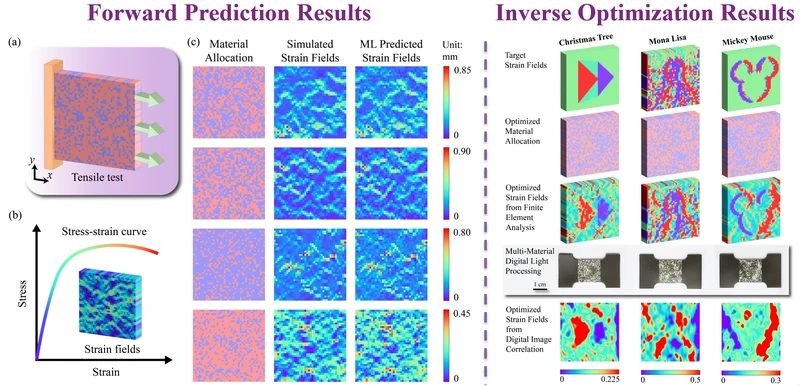
Comparison of target and machine-learning-predicted strain fields for hierarchical architectures

AI-Driven Inverse Design

Inverse design of strain fields

Problem
Manual exploration of hierarchical material layouts is slow and combinatorial.
Approach
RNN surrogate modeling paired with evolutionary optimization.
Outcome
Target strain patterns translated into architectures and compared across prediction, simulation, and experiments.
Read the paper (opens in a new tab)
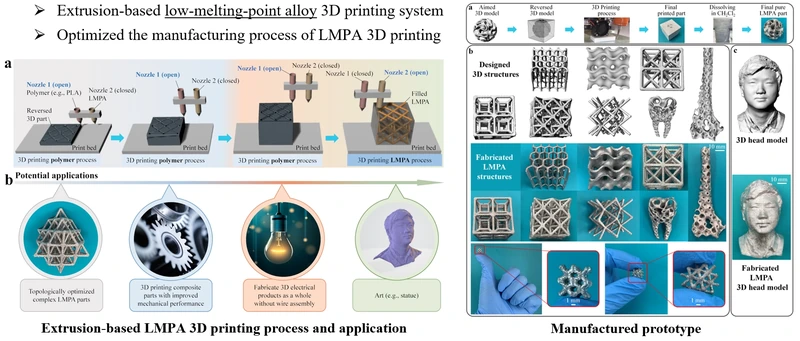
Low-melting-point alloy components and polymer-metal structures produced through extrusion additive manufacturing

Multimaterial Additive Manufacturing

Extrusion printing with low-melting-point alloys

Problem
Complex functional metal parts are difficult to fabricate with low-cost extrusion systems.
Approach
A dual-nozzle process integrates polymers and low-melting-point alloys.
Outcome
Multifunctional metal–polymer architectures for mechanical, energy-absorption, and electrical studies.
Read the paper (opens in a new tab)
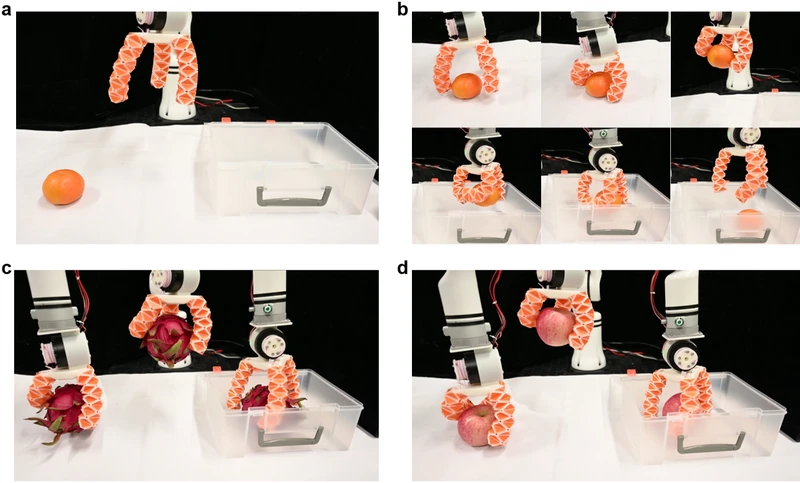
Origami-inspired flexible robotic grippers fabricated with hard-soft multimaterial 3D printing

Intelligent Structures & Soft Robots

Origami-inspired compliant grippers

Problem
Soft grippers need both compliant motion and predictable mechanical performance.
Approach
Origami geometry with hard-soft coupled multimaterial 3D printing.
Outcome
Programmable folding mechanics with grasping demonstrated across multiple objects.
Read the paper (opens in a new tab)

Selected publications

Work spanning methods, materials, and robots

Representative publications are selected for their connection to my current research themes. The complete list includes journal articles, reviews, and conference work.

View all publications

Latest news

Recent milestones

All news

Hong Kong · ICAST 2026

Received the Best Poster Award

Recognized at the 35th International Conference on Adaptive Structures and Technologies.

Short bio

Designing matter that can adapt, respond, and work

I am a researcher in mechanical and automation engineering whose work combines machine learning, computational mechanics, and multimaterial additive manufacturing. I develop inverse-design methods for programmable materials, adaptive structures, and bio-inspired soft robotic systems.

My doctoral research at CUHK was supported by the Hong Kong PhD Fellowship Scheme, while a research visit at SUSTech broadened this work across intelligent material design, advanced manufacturing, and robotics.